
If you’ve never had an MRI before, it’s normal to feel a little uncertain. Here’s exactly what to expect at Sunset Hills Imaging, from preparation through getting your results.
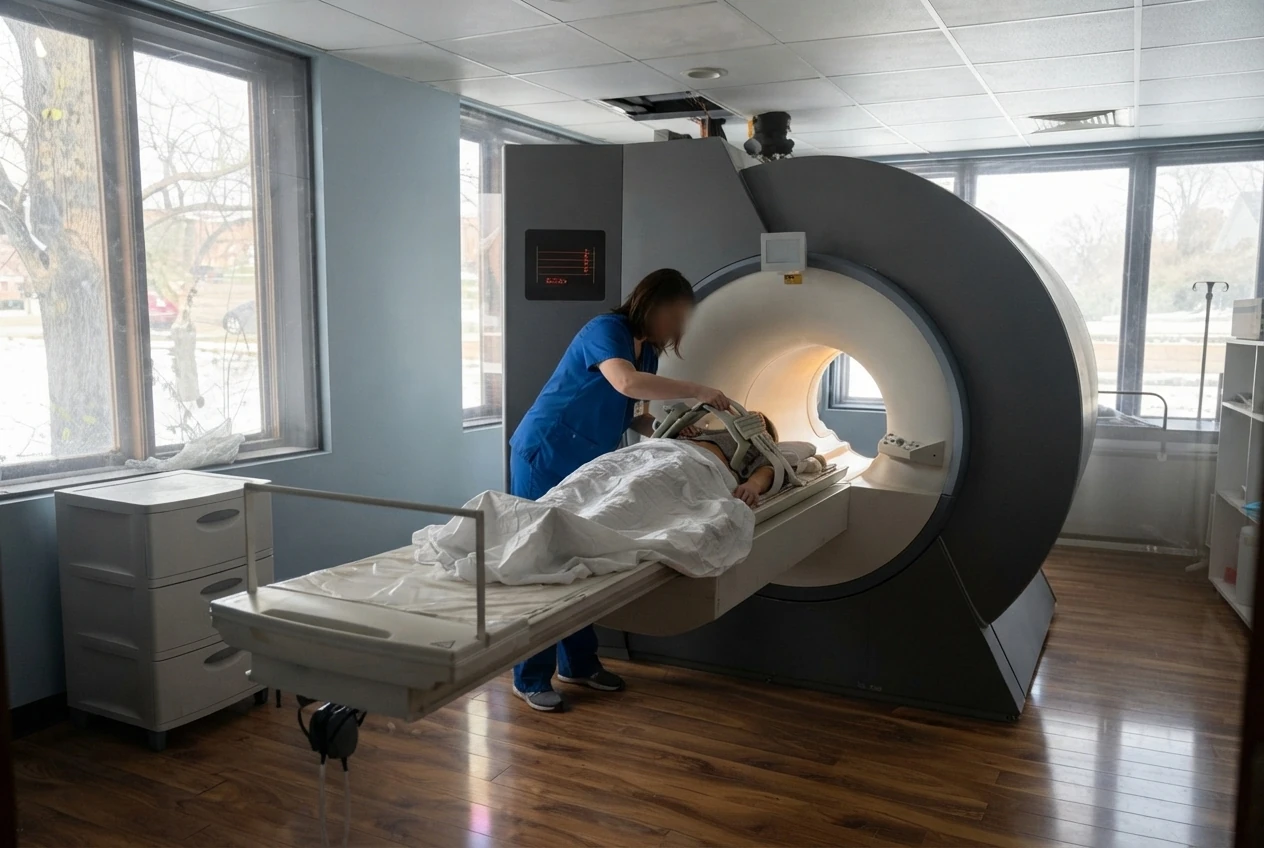
What is an MRI and how does it work?
MRI (magnetic resonance imaging) uses a strong magnet and radio waves to make detailed images of the inside of your body. The magnet aligns the water molecules in your tissue, radio pulses make them send back signals, and a computer turns those signals into cross-section and 3D images. No X-rays, no radiation.
Open MRI vs. closed MRI: which is right for you?
“Open” and “closed” describe the shape of the machine. A closed MRI is a tube the magnet surrounds completely. An open MRI has the magnet only above and below, with the sides open.
Both produce accurate images, but a closed MRI has a stronger magnet and sharper images, and it can scan areas an open machine can’t. Open machines mainly help people who feel panicked in tight spaces or who are larger in size.
Our scanner at Sunset Hills Imaging has a short bore — shorter than a traditional closed machine — which most patients find easier to handle. Your doctor will recommend what’s right for you.
How to prepare for your scan
- Bring your MRI order. Your provider can fax it to us at (314) 804-7226, or you can bring a printed copy.
- Wear loose, comfortable clothes with no metal — no zippers, snaps, or underwire. We’ll provide a gown if you need one.
- Leave jewelry and metal items at home. The scanner is a strong magnet and can pull metal toward it, which is dangerous and can damage the machine.
- Tell us about any metal in your body — a pacemaker, insulin pump, rods, screws, wires, cochlear implants, or anything similar. Some implants are not safe around an MRI magnet, so we need to know before scheduling.
- Tell us if you’re claustrophobic or have a condition like tremors that makes it hard to hold still. We’ll talk through your options before your appointment.
- No IV line or injection is needed. Our scans are non-contrast, so there’s no special preparation beyond arriving comfortably.
- Tell your provider if you’re pregnant.
Can I eat or drink before an MRI?
Yes. Eat, drink, and take your medications as usual unless your provider tells you otherwise. If you have an overactive bladder or frequent urgency, go easy on fluids before the scan so you’re comfortable lying still for 25 to 30 minutes.
Arrival and Check-In
Plan to arrive a little early, especially if you still need to fill out paperwork. Our front desk verifies your information and confirms the scan type, and we collect payment at your appointment — the flat $399 covers everything.
What to expect during the scan
- You lie down on the padded scanner table, and the table slides you into the machine. For many studies — like a lumbar spine scan — you go in feet first and your head stays outside the machine.
- Pillows, headrests, and straps keep you comfortable and in place.
- Your technologist works in an adjacent room, watching through a window, and talks to you through speakers. You can reach them at any time.
- The machine is loud — expect banging and buzzing as it scans. You’ll wear earplugs and over-ear hearing protection.
- You’ll breathe normally for most scans. If a sequence needs you to hold your breath, the technologist will tell you when.
- Most of our studies take 25 to 30 minutes of scan time, and some run up to about 45 minutes. Plan for up to an hour total in the department, including check-in and positioning. A board-certified radiologist reads every scan.
- When the scan is done, the table slides out and you’re free to go.
Claustrophobia and MRI scans: tips for coping
Claustrophobia is common, and our scanner’s short bore helps — the tube is shorter than a traditional closed MRI. A few things that can also help:
- Learn what to expect beforehand, so nothing surprises you.
- Close your eyes or wear an eye mask so you don’t see the enclosed space.
- Use the earplugs and hearing protection we provide.
- Focus on your breathing to keep your mind off the machine.
How long does an MRI scan take?
Most of our studies take 25 to 30 minutes of scan time, and some run up to about 45 minutes. The exact time depends on the body part and how many images are needed, so plan for up to an hour total in the department.
Are there any risks?
MRI is very safe when the safety guidelines are followed, and it doesn’t expose you to radiation. Because our scans use no contrast dye, there’s no risk of a contrast-related allergic reaction. The main safety issue is metal: the scanner’s magnet is extremely strong, which is why we ask about implants and metal before scheduling. The FDA’s MRI safety guidance covers this in more depth if you want the full picture before your appointment.
How much radiation is involved?
None. Unlike X-rays or CT scans, an MRI uses no radiation.
Who reads the images?
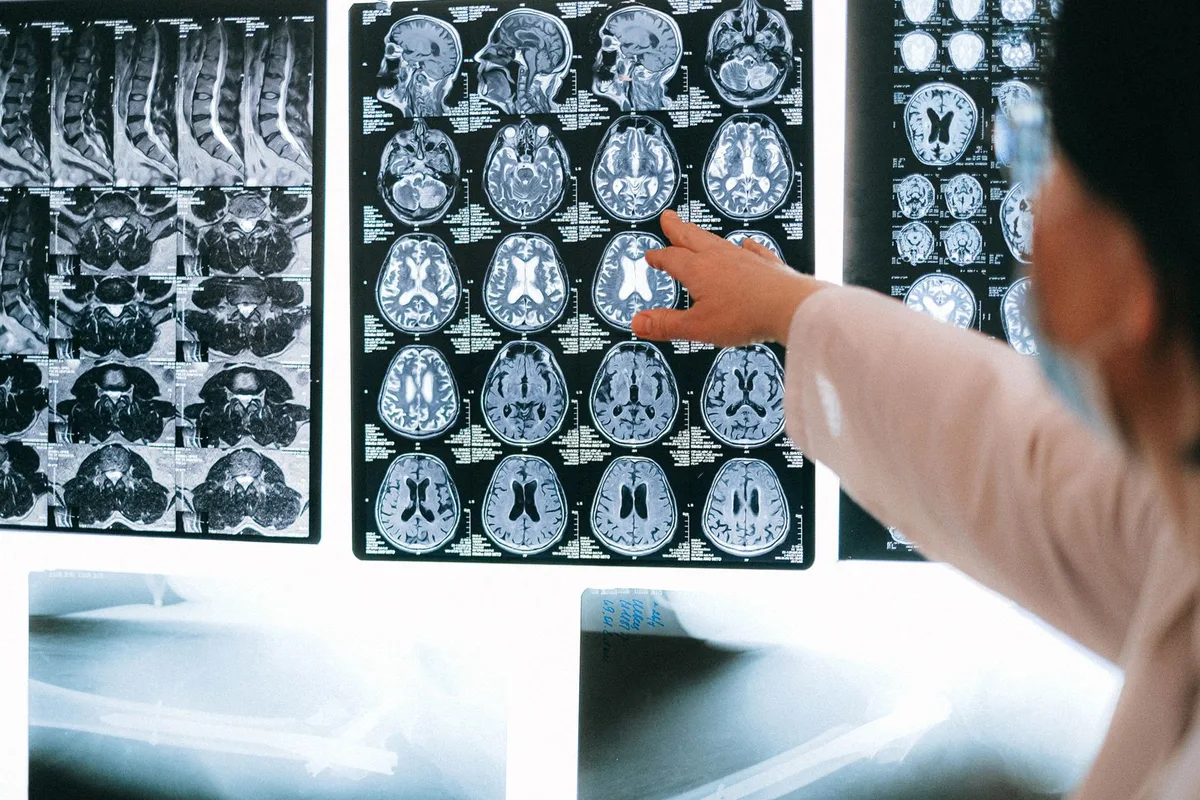
A board-certified radiologist reads your scan and writes a report of the findings. The report goes to your doctor, who uses it to make a diagnosis or plan treatment. Ask us and we’ll email you a password-protected copy.
After the Scan
You’re free to leave immediately — no recovery time is needed since we don’t use contrast dye. A board-certified radiologist reads your scan, and the report goes to your ordering provider within 24–48 hours — ask us and we’ll email you a password-protected copy. You’ll also receive a CD of your images.
The MRI doesn’t fix anything on its own, and it never promises a certain result. It points you and your doctor in the right direction — even an unremarkable report is useful information.
What does an MRI cost?
MRI prices vary widely, depending on the body part, the facility, and where you live. At Sunset Hills Imaging, every non-contrast MRI is a flat $399 — the scan, the radiologist’s read, and a CD of your images, with no facility fee and no separate bill. Our pricing page shows how that compares to hospitals.
MRI vs. CT scan: what’s the difference?
- MRI uses a magnetic field and radio waves; a CT scan uses X-rays.
- MRI is better for soft tissue — tendons, ligaments, and internal organs.
- CT is faster and generally less expensive, and it’s better for bones and for trauma situations.
- MRI uses no radiation; a CT scan does.
- Metal in the body can rule out an MRI, while CT is usually still possible.
Sunset Hills Imaging
Sunset Hills Imaging is an outpatient imaging clinic in St. Louis. We perform non-contrast MRI studies only, at a flat $399 per scan, and we don’t bill insurance. You just need a doctor’s order. If you need more than one scan, each one is $399.
Driving in? See the route from your town: I-44 West, I-55 South, or I-64 East (Illinois).
Still nervous?
Call us at (314) 834-7226. We’re happy to walk you through anything before your appointment. Many of our patients are first-timers, and our team is used to making the experience as smooth as possible.