
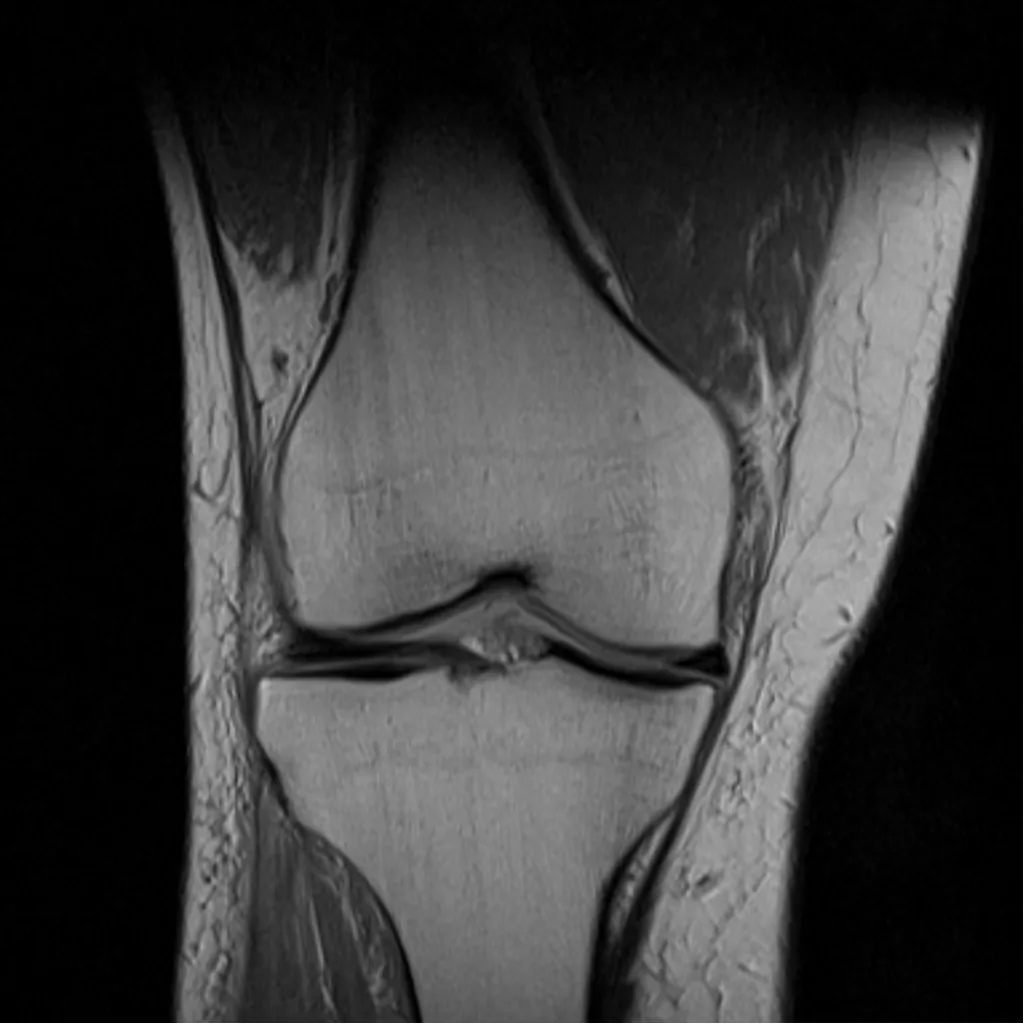
A knee MRI is the standard study for internal knee injury. An X-ray shows bones; a knee MRI shows the soft tissue that X-ray misses entirely — the menisci, the ligaments, the cartilage, and the tendons around the joint. If you’ve had a twisting injury, a “pop,” or swelling that won’t settle, this is often the study that answers why.
What the Scan Covers
The radiologist reads the images for a specific set of problems:
- Meniscal tears. The medial and lateral menisci are the shock absorbers between the thigh bone and shin bone. Tears are common in twisting injuries, and the report describes the tear type and location.
- The four major ligaments. The ACL and PCL cross inside the joint, and the MCL and LCL run along the sides. The scan can show partial and complete tears, and in a previously reconstructed knee, the condition of a graft.
- Cartilage. The scan shows the cartilage surfaces of the joint, including thinning, defects, and early wear.
- Tendons and soft tissue. The quadriceps and patellar tendons, the structures around the kneecap, and any cysts or fluid collections.
- Bone. MRI can also show bone marrow edema, stress reactions, and small fractures that don’t show up on X-ray.
When Your Doctor Orders One
Knee MRIs are most often ordered after a twisting injury, when you felt a pop or your knee gave way, when swelling persists, or when the knee locks or catches. Orthopedic surgeons routinely require the scan before arthroscopy, because it shows the surgeon what’s going on inside before they operate.
The Honest Caveats
Not every knee problem needs an MRI, and we’ll tell you that straight. If the question is primarily arthritis, a weight-bearing X-ray is often the more appropriate and cheaper first step. MRI is at its best when soft tissue injury is suspected. And if your knee is painful but the story is a gradual ache with no injury, your doctor may well start with conservative treatment and imaging later, if at all.
What the Visit Is Like
For a knee MRI, you lie on your back, feet first, with your knee in a dedicated coil. Your head stays outside the scanner for the whole study, which makes it one of the easier exams for people who feel claustrophobic. The scan takes about 25 minutes, the whole visit runs about an hour including check-in, and you’re free to go as soon as it’s done.
One practical note: each knee is a separate study, so if you need both scanned, that’s two appointments’ worth of coil setup and two scans. Most patients start with the symptomatic side.
What Happens After the Scan
Your scan is read by a board-certified radiologist, and the report goes to the provider who ordered it within 24–48 hours. If surgery is a possibility, the surgeon uses the report to plan the procedure — whether that’s trimming a torn meniscus, reconstructing a ligament, or deciding that surgery isn’t the right step. A knee MRI doesn’t decide treatment; it gives the people making treatment decisions the information they were missing. And if the report comes back unremarkable, that’s still a useful result — it points the plan toward strengthening, unloading, and physical therapy rather than surgery.
What It Costs
A knee MRI at Sunset Hills Imaging is a flat $399, same as every scan we run. That includes the scan, the board-certified radiologist’s read, and a CD of your images — no facility fee, no separate reading fee, no surprise bill. The pricing page shows how that compares to hospital billing. If you have a doctor’s order, call (314) 834-7226 and we’ll get you scheduled.